

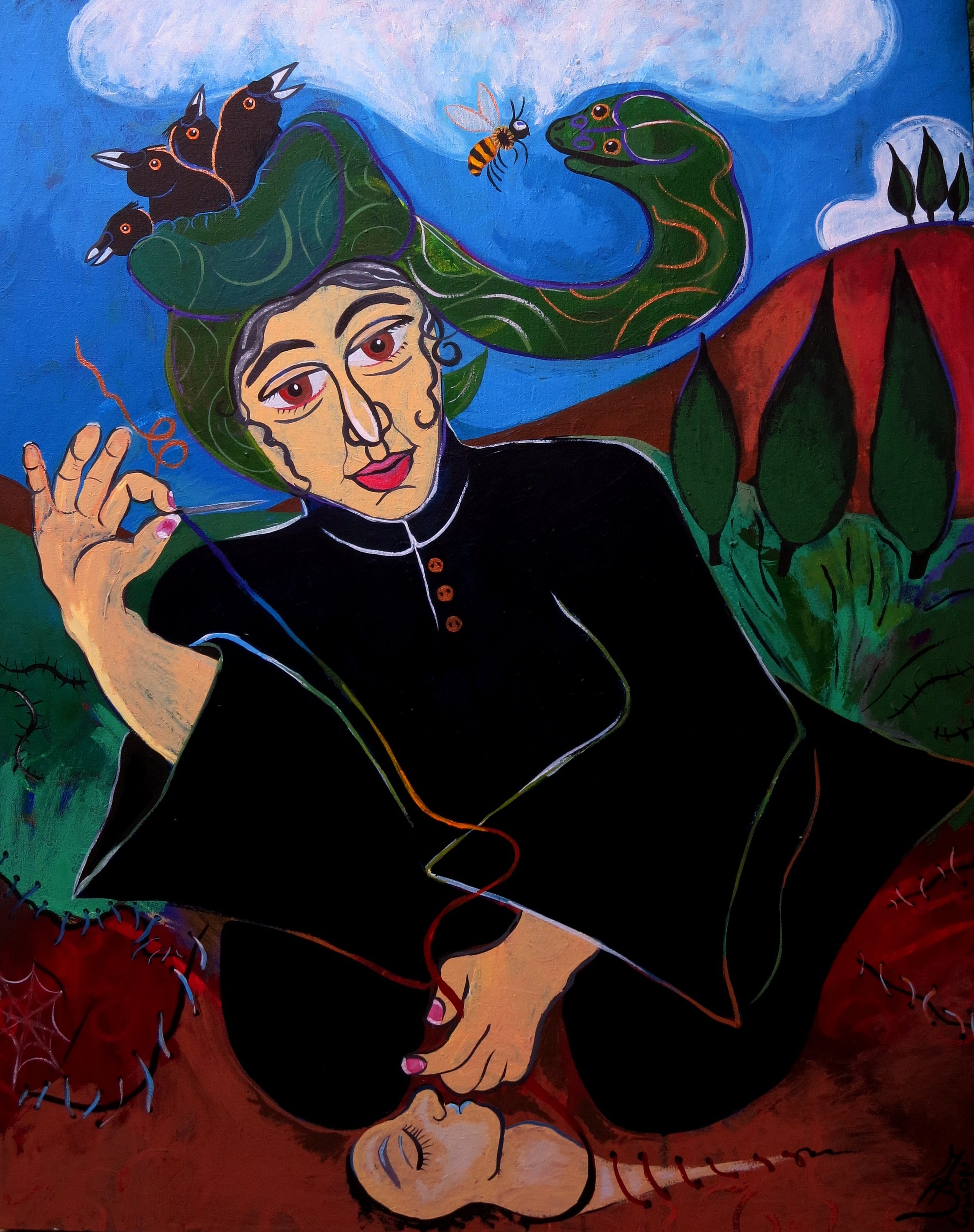
THE ABSENCE OF THE DEAD IS THEIR WAY OF APPEARING
This painting was inspired by a book by Mary Winfrey Trautman, but the actual words in the book title are by the French philosopher Simone Weil. (A full explanation appears at the end of this essay).
Here in the UK our MP’s (Members of Parliament) voted last week on a bill to legalise assisted dying in England and Wales. This is a very emotive subject and strong opinions were voiced on either side of the argument (for and against). Polls showed that 66% of the UK popular was in favour of assisted dying (this means: physician or medically assisted dying, not regular citizens assisting with suicides, so the correct word here is euthanasia). We can certainly conclude that the votes of the MP’s reflected the majority view of the population.
The bill sets out specific requirements for who is eligible to receive assistance, including the need to have the "mental capacity to make a choice" (which excludes all people with dementia and also all people with significant learning disabilities) and that they must have a formal medical status predicting that they are "expected to die within six months". Two independent doctors must make assessments before a high court judge then makes a final ruling. SOURCE
My country of birth, The Netherlands, legalized assisted dying in 2001. I personally know people who chose to die that way (e.g. because of end stage ALS). It is interesting to note how assisted dying is legal, and accepted by most citizens, in some countries but a crime and taboo in neighbouring countries. (Some would call this norm-shifting!)
The main argument for assisting dying is that it upholds the human right of personal and bodily autonomy. People want two key things: dignity and a way or option out of unbearable pain or suffering. People often say: “We treat our pets better than dying loved ones. We would not dream of letting a pet suffer at the end, we help them “fall asleep” (euphemism).
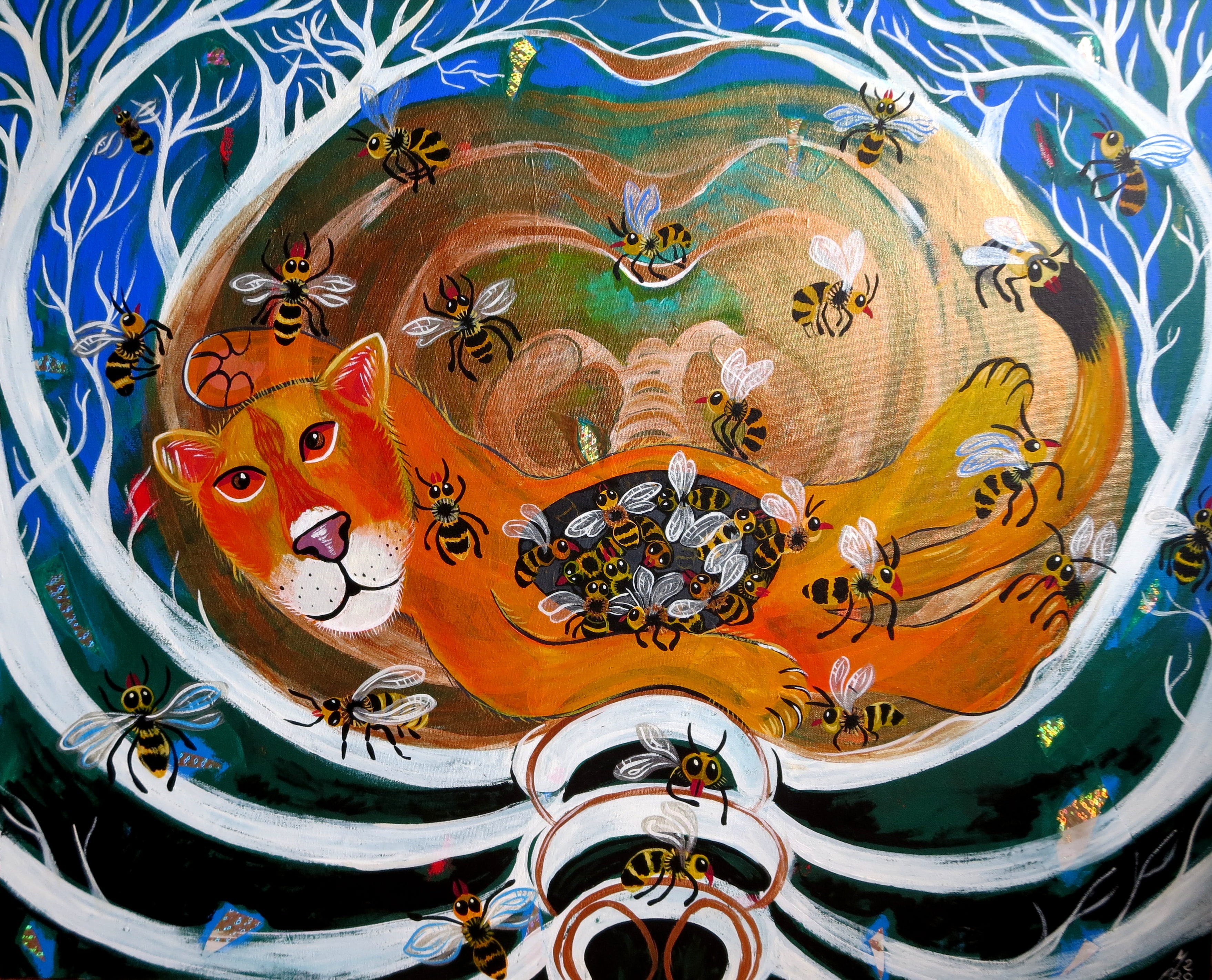
DISMEMBERMENT: THE LION AND THE BEES
"Some time later, when he (Samson) went back to marry her, he turned aside to look at the lion's carcass, and in it he saw a swarm of bees and some honey." (Quote from the Holy Bible)
The main argument against assisted dying appears to be the fear of a slippery slope: sick, elderly or severely disabled people feeling like a burden on others, or being put under pressure to end things (so other people are relieved of care burdens, or receive their inheritance, more quickly).
The obvious course of action here is to study very meticulously what is actually happening in countries like the Netherlands and Canada. (Again, personally speaking I have heard some dubious stories from my fellow Dutch citizens, so I am not denying that a slippery slope does exist!) There are other arguments too, of course, but some doctors have always abused their positions. Nothing in society is ever 100% watertight.
Another concern that has been flagged here in the UK is that our NHS ( the underfunded National Health Service, providing medical care free of charge to the entire UK population) is already at breaking point and unable to cope with this properly (following the rule book to the letter). This is a very real concern in a broken and buckling system.
However, I also think that if people (only those of sound mind who consciously choose this path!) die less drawn-out deaths, then that would cut expenditure on the side of days of medical professionals administering medical or palliative care/monitoring/pain relief or even sedation. We should never implement the bill for this reason, but it would obviously be a (long term) side effect, especially if an uptake in significant numbers occurs.
Western society glorifies youth but is in denial about death. Death is hidden from view. Adults who do not have a good handle on death inevitably raise children who are ill-equipped to handle death in positive ways. By this I mean: recognising the signs of its imminence and performing all necessary actions without flipping into either complete denial or being so overcome by grief that they can not function effectively.
Please note that in my books I always capitalise the word death (so Death) when I speak of the great cosmic force that will come for us all. I use the lower case word for personal death (“death”).
So what do I really think about this, as a shamanic teacher, someone who teaches Death & Dying & Psycho Pomp work?
Obviously I have not yet died, but I have been present at deaths and I also do shamanic death preparation work with terminally ill people.
I have slowly but certainly arrived at the conclusion that, assuming we die a natural death (accidental or violent deaths “belong to a different chapter of shamanism” and I have an upcoming essay about that in my Draft Folder), the way we die often heals or balances/completes something that we were lacking in our life.
Let me take my mother’s death (in August 2022) as an example. In the months before her death she was in and out of hospital. She was sent home with a leaflet about Heart Failure, what it is and the kind of death you can expect if you die from it. The day came where my mother opted out of bouncing back and forth between home and hospital. She said that she “just could not do that any more”. She was told that her decision would be honoured, by both medical professionals and her three children, but this meant that her death was now imminent. And indeed, within about a week she entered what I call (not sure this is a medical term!) the active dying phase. By this I mean that the journey is medically irreversible, death is the only outcome now.
One by one her organs started giving up. She was on a morphine drip, and I was taught how to use it. I was even taught how to override it and administer extra doses (e.g. at night when there were no medical professionals available, remember: she was dying at home!) After a few days even that was not enough. She was restless, clearly uncomfortable and also very confused.
My brothers and I called in a medical doctor and asked her to authorize sedation. This was put in place, meaning that my mother would now “sleep” (artificially) until she passed. Her heart kept beating and beating, against the odds. My brothers and I said: Heart Failure? Really?! It was the only organ that wasn’t shutting down. Even her breathing had slowed to the lowest and shallowest possible mode.
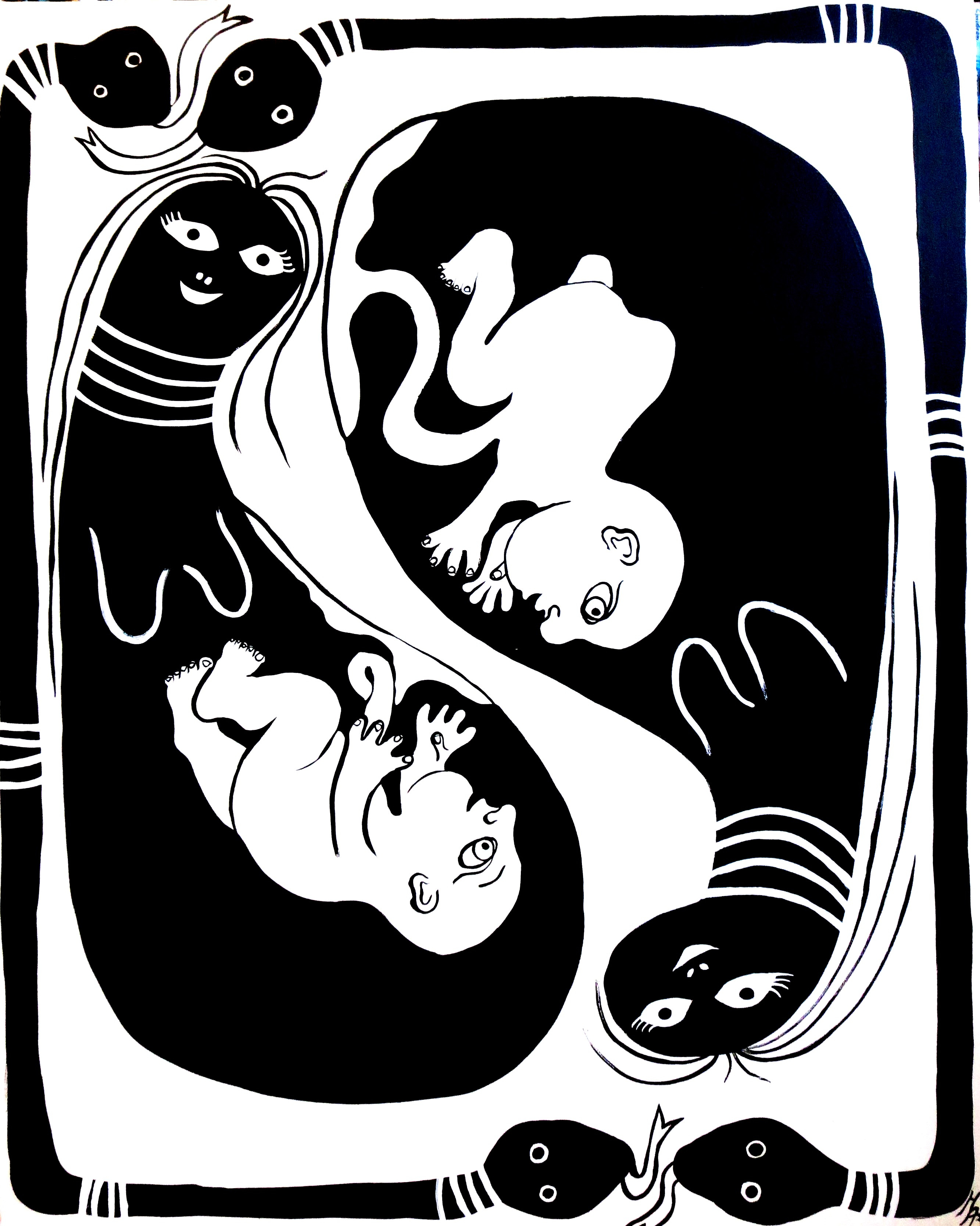
COMMUNICATING
However, what was also happening is that she was handled like a baby. Her bedroom had become a Temple, the Holy of Holies, where she was the sole focus of attention, the only priority. Everyone who entered (even the medical and nursing professionals) were loving and reverent, in the Presence of Death. She was wrapped in love, spoken about with love, touched with love. If anyone started an uncomfortable discussion I would immediately shepherd them about of my mother’s bedroom. (Hearing is the last sense to go!) And believe that this was what she most needed! What she was staying for, beating all the odds. (We kept being told, day after day, by all medical professionals that “she would definitely not make the evening!”)
My mother was the only child of a narcissistic mother, who did not only abuse her in horrible ways, but who also told her frequently what an ordeal her birth had been. “I had never experienced such pain in my whole life. You nearly killed me!” (This script repeated when my mother nearly died giving birth to me, her first child). Without going into too much personal detail I believe that my mother’s death was all about regressing to her baby self or infantile state of functioning (being toileted, being washed, being dressed, being told how adorable she was) to heal what happened at the beginning of her life. My brothers and I did night watches (as well as day watches). We played her all time favourite piece of music, The Final Chorus of J.S. Bach’s St Matthew Passion on loop. (She sang in the church choir and was also the church organist for decades. See THE CHILD ORGANIST).
After several days she did slip away, just before midnight. For me the most profound lesson was that she had needed one week of unconditional love and acceptance lavished on her (without anyone holding back) before she could walk into the Embrace of the Ancestors. This is the same thing I wish for myself, when my day comes. Western society disregards the spiritual dimension, but we don’t know the Big Soul Work that goes on in places that look like limbo to a casual observer. (Admittedly there was also the exhaustion of not sleeping for a week and then organising a funeral!)
A similar thing happened with my father (dying of terminal cancer in hospital). I sat with him the entire day he died. Because of sedation he was already out of reach, in terms of direct personal conversation, but a lot happened that day. He himself (his Higher Self or Soul, if you like) came and explained certain life choices and family patterns to me. He said that he had hoped to be a healer of ancestral trauma, but he had failed, so it was over to me now to complete the task. His (long dead) mother calmly sat in the chair by his bed, ready to welcome and embrace him. There was one person in particular, a boy from his childhood village who had died young and who stood close to his bed. We never managed to figure out his identity. It was too long ago and my father wasn’t able to speak any longer.
I asked the spirits: why did he have live through such horrific pain, it seemed inhumane! They said: “Without the pain he could never have accepted that it is his time to go. The pain was about growing into acceptance and letting go”. When he breathed out and it wasn’t followed by an in-breath, I felt as proud of him as I did when our eldest son took his first baby steps in our kitchen. He has done it! He has stepped into the other world with courage and without looking back!
Having said that, both scenarios hinge on adequate pain management. When I gave birth to our first son, many people said: go for an epidural!! I did and regretted it profoundly. When it was time to push he got stuck because I could not feel properly what I was instructed to do (the midwives had made sure the epidural had worn off by then). Therefore: a shocking level of pain but no progress!
We narrowly avoided a forceps delivery and eventually he came out with his little nose flipped sideways. With our second and third son I knew the pain level involved in giving birth, but I also knew, from “lived experience” that there was a baby at the end, whose fate might be impacted by any pain relief I used. So I declined all pain relief and I felt in control during those births. I could follow instructions and feel/track the progress of the descending and moving baby.
However, with son number #1 (I went into labour on Tuesday evening and by now it was Thursday evening!) there was a moment of despair where the Gates of the Land of the Dead loomed large in the otherworldly fog. This baby suddenly seemed like the worst idea we ever had. I just wanted the pain to STOP. Failing that, I wanted to die. Whatever it took, I could not handle the pain any longer!! Now, I don’t know about the pain level (some) people experience when they die, but I do know that human consciousness can narrow to a tunnel or even dot: MAKE THE PAIN STOP!!!
I do not believe that someone who dies feeling that they are being tortured, is a good death. It may be a “natural death” (without medical intervention) but not a death where someone consciously steps into the other world.
I also acknowledge that people who are not remotely spiritual, will not want to “consciously step out of their human body”, they want “it” to be over quickly.
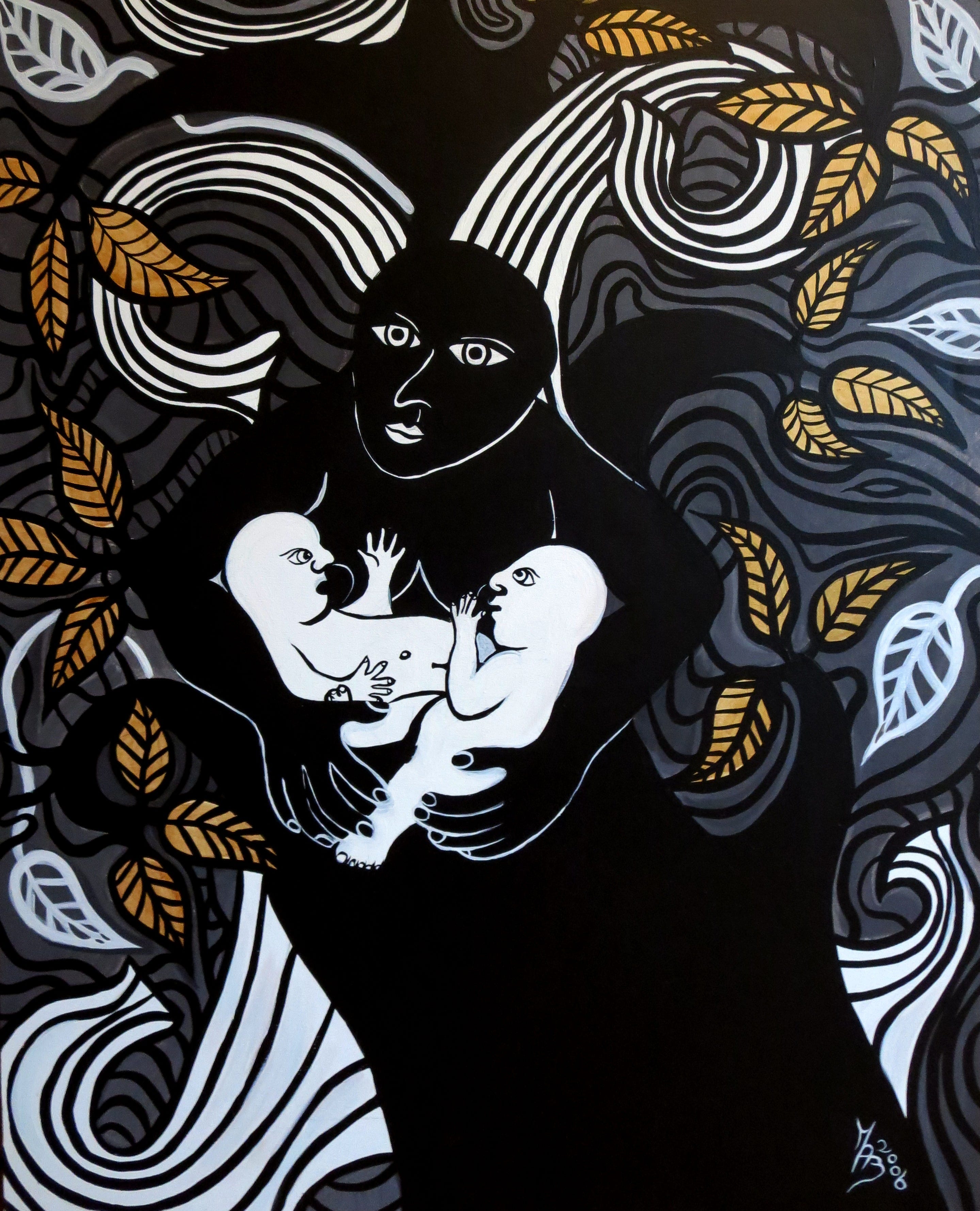
For that reason I am for assisted dying. It should be only one option on a much larger menu and no one should ever be pressurized into it. But some people will have a calmer old age (or more peaceful period of decline from terminal illness) if they know that this option is open to them (under the most stringent restrictions and checks). It also means not needing to badger family members into accompanying you to Dignitas in Switzerland (which until now carried a risk of police arrest and prosecution for them!), or indeed, dying much earlier than necessary because you still need to be able to travel internationally (and independently) to gain access to this service.
For myself I hope that, if I die from either old age or a terminal illness, that I will carers who neither rush me into death nor watch me writhe and scream with unbearable pain (and why are those people, who are beyond sedation and morphine, not put under general anaesthetic until death has run its course, if euthanasia is unlawful?)
That is my take and it is a personal take! Everyone is entitled to their own opinion. This piece was written because several people have asked me to write more about death and dying. Sure! So if I could give two pieces of advice to the living, those would be:
Attend a death, if at all possible. Actually watch someone die, without hiding behind your phone or leaving the room (unless you sense that the dying person needs you to leave the room, so they can die in peace. This is not uncommon!)
Your cosmology in life will dictate (and drive) how the Afterlife, other worlds and spirit helpers, appear to you in the moment of death. Christians will see angels or Mother Mary. Vikings might see Odin. Agnostics (and people of all denominations) might hope to see loved ones again. Work out where you stand. What do you believe and why? Do you believe in any power(s) greater than yourself? Do you believe in the continuation of consciousness after death? Set a strong intention in terms of whom you want you to meet on arrival. It may carry you through…
Last but not least a few words about the painting at the top of this essay: the title was taken from a book by Carol Trautman, describing her daughter’s death from leukaemia (perceived as a powerful White God), published in 1984. However, Trautman borrowed those words (also the title of this essay) from the French philosopher and mystic Simone Weil.
The painting was inspired by a dream where a Great Goddess embodying (or personifying) Death appeared and returned the bodies of dead souls to Mother Earth with immense gentleness and compassion. She lovingly stitched the bodies of the deceased into the Earth, the way we put a baby to bed. This way human bodies return to their Ultimate Mother (Mother Earth) and their souls are free to return to the Spirit World and continue their larger cosmic journey. It was a very powerful dream and I have often seen glimpses of this figure since, as our world continues to move through Days of Darkness and Dire Beauty.
I try (but sometimes fail) to get out at least one essay a week (sometimes more), due to travel, international teaching commitments and family care responsibilities (our family lives with Alzheimer’s and I have written several posts about that). All artwork and photographs shown in Substack posts are my own, unless credited differently! If you would like to see regular posts about about Nordic spirituality and my life as a Forest Witch (and of course short videos of all the wildlife in Sweden!), please follow me on Instagram or Facebook, thank you!
Imelda Almqvist, London UK
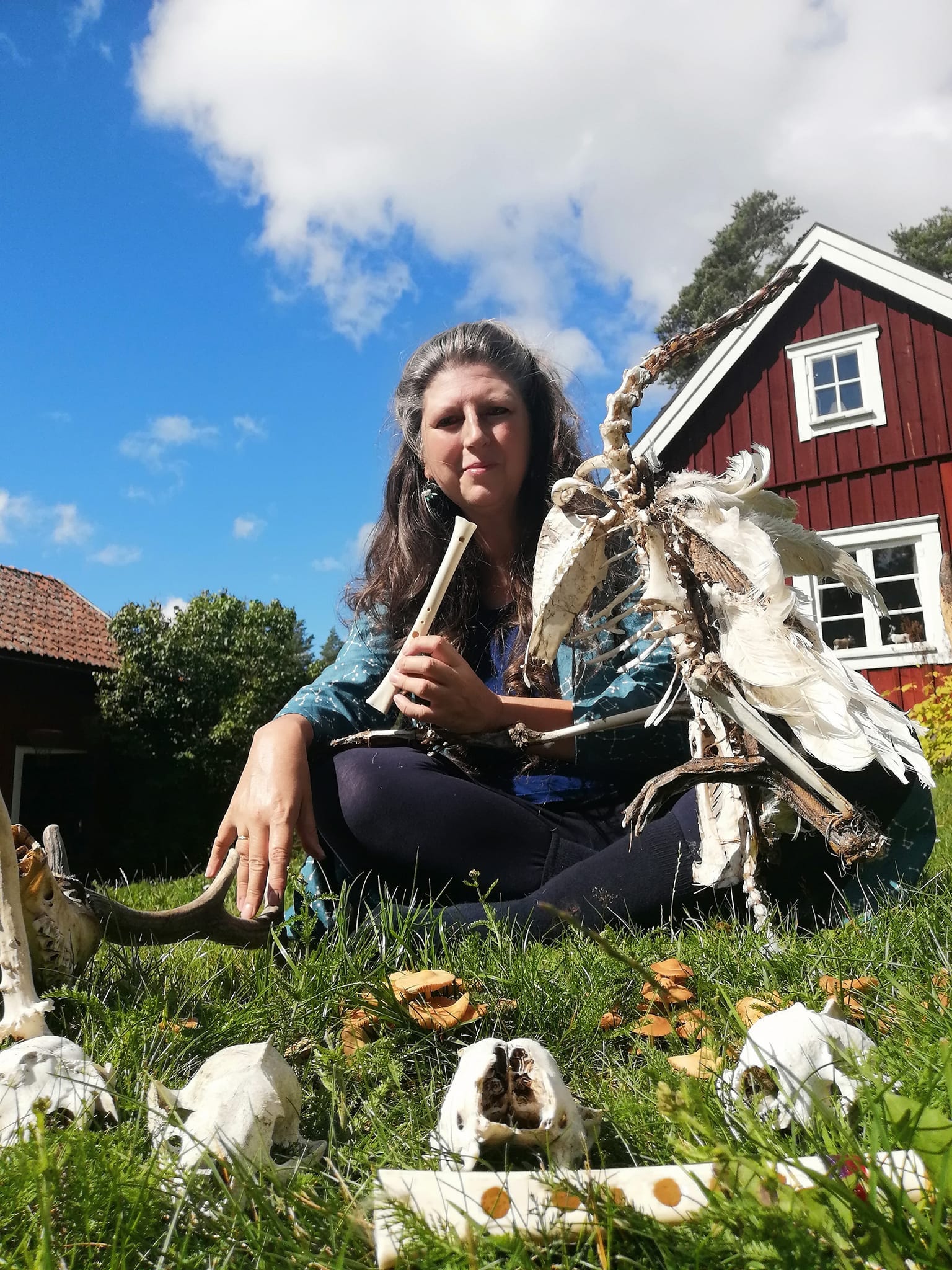
BIO FOR IMELDA ALMQVIST
Imelda Almqvist is an international teacher of Sacred Art and Seiðr/Old Norse Traditions (the ancestral wisdom teachings of Northern Europe). So far she has written four non-fiction books and two picture books for children. Natural Born Shamans: A Spiritual Toolkit for Life (Using shamanism creatively with young people of all ages) in 2016, Sacred Art: A Hollow Bone for Spirit (Where Art Meets Shamanism) in 2019, Medicine of the Imagination - Dwelling in Possibility (an impassioned plea for fearless imagination) in 2020 and North Sea Water In My Veins (The Pre-Christian spirituality of the Low Countries) was published in June 2022.
The Green Bear is a series of picture book for children, aged 3 – 8 years. The stories and vibrant artwork, set in Scandinavia, invite children to explore enchanting parallel worlds and to keep their sense of magic alive as they grow up.
Imelda has presented her work on both The Shift Network and Sounds True. She appears in a TV program, titled Ice Age Shaman, made for the Smithsonian Museum, in the series Mystic Britain, talking about Mesolithic arctic deer shamanism.
Imelda is currently working on a handbook for rune magicians (about the runes of the Elder Futhark) and on more books in the Green Bear Series. Imelda runs an on-line school called Pregnant Hag Teachings, where all classes she teaches remain available as recordings, which can be watched any time.
Website:
http://www.shaman-healer-painter.co.uk/
YouTube Channel: youtube.com/user/imeldaalmqvist
Online School: https://pregnant-hag-teachings.teachable.com/courses/
Facebook: https://www.facebook.com/imelda.almqvist/
Instagram: https://www.instagram.com/almqvistimelda/
Imelda (The Pregnant Hag)
Substack is messing with the posting button, so in reply to what Terry wrote: Thank you for making that distinction, between assisted dying and health-care provider administered dying. I know that to use the Dignitas service in Switzerland people must be well enough to drink the lethal potion or administer the lethal injection to themselves. I will need to look into this for the UK. In the Netherlands I believe health care provider administered IS an option because someone with advanced ALS can no longer lift a cup or indeed use any muscles at all... (Someone in my family had very advanced ALS and opted for assisted dying).
And I do agree that "ending the suffering" is often more about the discomfort of the observers. And it is HUGELY important to make the distinction between those two things... so thank you for adding that piece!
And next time I write about the NHS I will emphasize tax-payer funded. Obviously medical care can never be a free resource!!
I don't know about medical education in the UK. When I was doing hospice medical education, years ago, I'd ask my students 4 questions:
1. In 4 years of medical school, how much time (hours, days, weeks or months) was required (NOT elective) in the study of human growth and development, obstetrics, pediatrics, care regarding the beginning of life? (the answer to this question was usually at least 6 months)
2. As a practicing physician, what percentage of your time do you expect to be investing in care for pregnant women, infants, children? (for family physicians the answer to this question was maybe 20-40%. For internal medicine physicians the answer to this question was usually something like "if I have to deliver a baby at the opera? If my next door neighbor wants me to check if their child has an ear infection?")
3. In 4 years of medical school, how much time (hours, days, weeks or months) was required (NOT elective) in the study of geriatrics, hospice and palliative care, care regarding the end of life? (the answer in my own case was 1 week of geriatrics and 2hr lecture on advanced directives, now-a-days it is maybe a couple of weeks)
4. As a practicing physician, what percentage of your time do you expect to be investing in care for those >65years old and/or the dying? (for nearly everyone the answer to this question was at least 20%, usually >40%)
Bonus question #5: Do you expect to be involved in medical education? If the answer to this question was "yes" I would close with a plea to PLEASE rebalance this equation. Medical students do not even get introduced to a kind and gentle vocabulary to address the fact that We Are All Going To Die.