
MAY'S AWAKENING
The Month of Reindeer Calves!

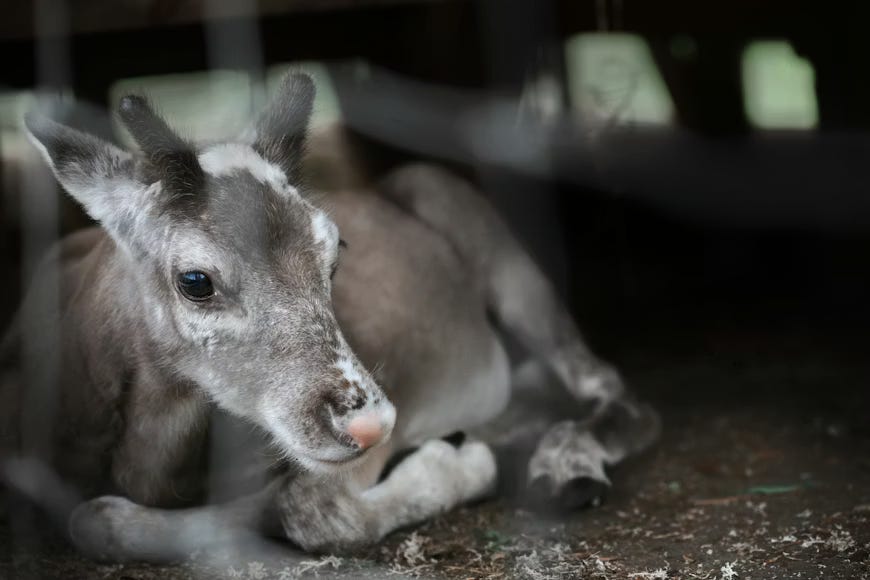
REINDEER CALF, picture credit: Kristin O Karlsen, UNSPLASH
In Northern Sámi the name for the month May is Miessemánnu, literally “the month of the reindeer calves”, because it brings calving season and newborn calves taking their first steps on spindly legs.
I love words for months and seasons which are both pragmatic and poetic!
In the list of Sámi months (please note that there are small variations between different Sámi languages and regions!) below, February is listed as Guovvamánnu, a word of unknown origin, referring to the second month of the Gregorian year. I did a bit of research and found the following reference in Swedish:
Februari har även ett annat namn på sydsamiska: Gierhken garres, dvs. den månad då järven är hård på renarna.
February also has another name in the South Sami language: Gierhken garres, that is to say “the month that the wolverine is hard on the reindeer”.
Here is the complete list:
January - Ođđajagemánnu - The New Year Month
February - Guovvamánnu Unknown
March - Njukčamánnu -the Swan Month
April - Cuoŋománnu - the Snow Crust Month
May - Miessemánnu - theReindeer Calf Month
June - Geassemánnu - the Summer Month
July - Suiodnemánnu - the Hay Month
August - Borgemánnu - the Molt Month
September - Čakčamánnu - Fall MonthOctober
Golggotmánnu - Rut Month
November - Skábmamánnu - the Dark Period Month
December - Juovlamánnu - the Yule Month
Further south, here in (east coast) central Sweden, the month of May has a unique quality, because the land is so verdant and luminous (because of the returning Midnight Sun). There was heavy snowfall in our area as recently as on April 4th and we still woke up to a “white world” this morning (due to night frost!) Our living room is currently acting as “a greenhouse” for baby plants, but the pockets of snow on the Forest Edge have finally disappeared!
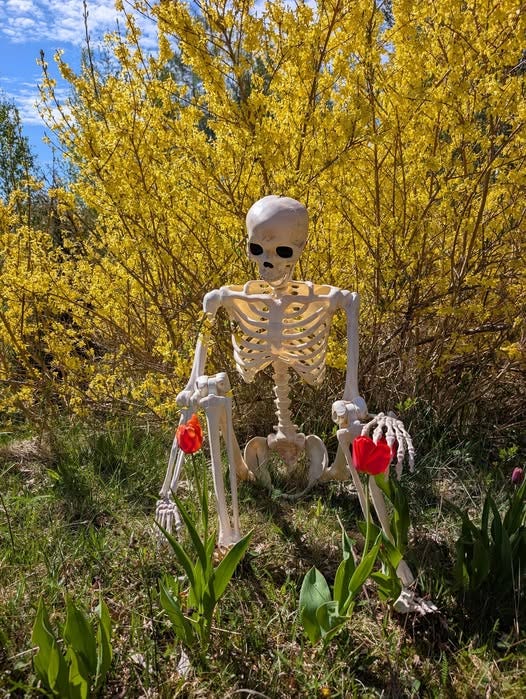
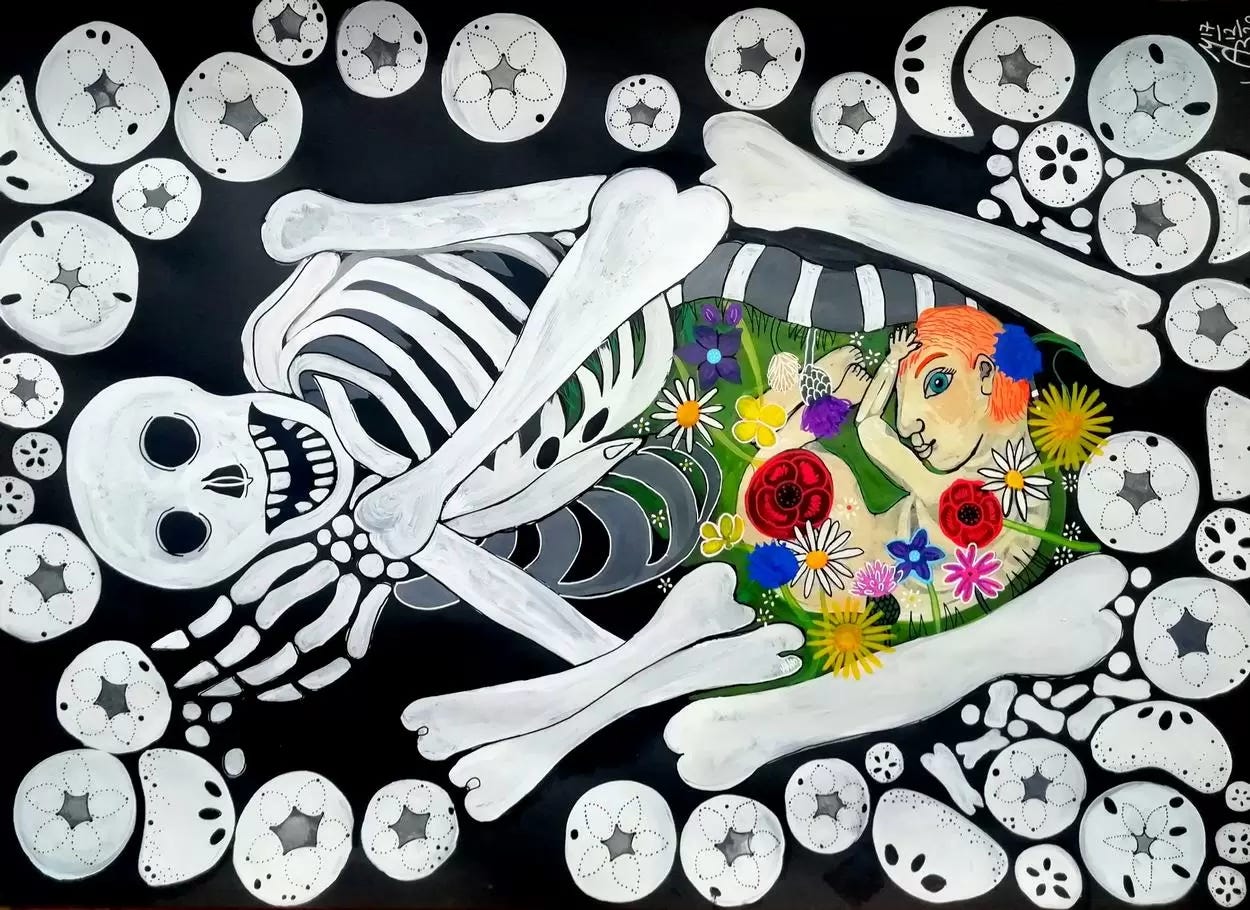
THE SECRET GARDEN OF THE BONE MOTHER?
Title of a painting by the author:
In London the forsythia blossomed fully two months ago but here in Sweden it is in full bloom right now. We also have daffodils and tulips (my husband planted some bulbs a year ago).
The deer does are pregnant and a little slower, a bit less agile. Two cranes visited this morning. They didn’t seem to have chicks with them but it is early days for hatching. Also, I didn’t have the binoculars on me, so I live in hope!
I am writing this draft on May 8th and the sun rose at 4.32 a.m. this morning. She, Sunna, will set at 9:00 p.m. Soon the stars will disappear until August, as the days grow longer and longer until there is no more night and we say goodbye to the star-spangled goddess Nótt for some time.
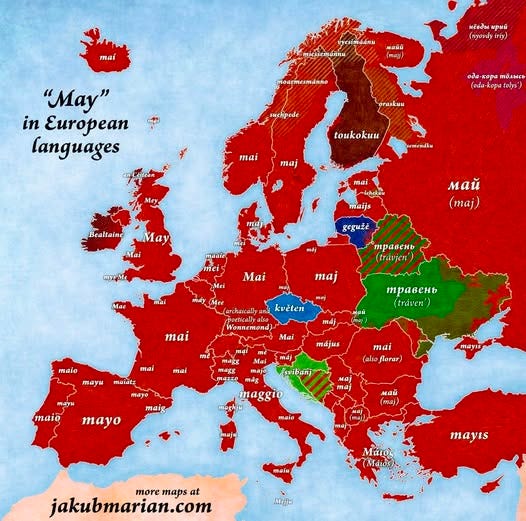
The word for this month in most Western European languages is May (with variations in spelling) and named for the Roman goddess of growth: Maia. Her is name is believed to be related to the Latin word maior (larger or greater) and may well originate from the PIE (Proto Indo European) word magya: “She who is great”).
In Swedish it is maj and in Dutch Mei.
In Finnish the May month is called Toukokuu, literally “The Sowing Moon/Month”.
In Ukrainian and Belarussian the word “traven” is derived from a Slavic word for grass.
In Czech May is “květen” and it was made up by revivalists in the 19th century (because the Czech language came close to extinction at that time). [Not to be confused with Ukrainian Kviten (квітень), which is the Ukrainian word for April!]
In Karelian oraskuu is the “sprouting month”.
In Old Hungarian May was called Pünkösd hava, the Month of Pentecost. I found one reference to it being called “The Month of Promise” before Christianisation (and the Gregorian Calendar), but I could not find any supporting evidence for that. In modern Hungarian May is called Május. SOURCE
In Basque it is maiatza, which means “big” and refers to growth (the time of sap rising).
If we leave Europe for a moment, we discover that in Japanese May is Satsuki, meaning “rice planting month”.
In Vietnamese it is “tháng năm”. Tháng means five, plus a number: Month Five.
In a similar fashion, in Chinese it is 五月 (wǔ yuè): Five Month (Fifth Month, literally “Five Moon”, if you read the kanji or glyphs).
In Hindu it is वैशाख or Vaishakh.
In modern Greenlandic it is Maaji (derived from the Danish word for May, maj). The older original name is preserved in Inuktitut: Nurraliuti is the name for May in the Nunavik region in Arctic Canada. “It refers to the time of year when caribou start having their babies or calves.” (Think back to the Sami term I opened this article with: Miessemánnu is “the month of the reindeer calves”).
In the Baffin region, May is melting season and it’s called “Tupiqtuut,” which means “we are finally able to put our tents up in that month. Here is the reason: Because if you’re still trying to make snow houses, the ceilings can fall down. So everybody’s telling each other ‘it’s time to put your tent up”! SOURCE (And just for comparison: in Nunavik, February is Avunniti, which (sadly) has to do with the observation that bearded seals in the region often have miscarriages).

Photograph by Gerrit Stam on UNSPLASH
In Igbo (the language of a large ethnic group in Nigeria, Africa) May is Ọnwa Agwụ (ah-GWOO, month of the Agwụ deity. Agwu Nsi is the patron of divination, herbal medicine and creativity). SOURCE Agwu is a capricious being, who straddles moral opposites. He provides support but also seeds confusion…
Nigeria is in Western Africa and obviously has a very different climate from Europe. However, what got my attention is the trickster element:
Agwu bestows wealth, good fortune, and fertility upon individuals. Agwu is also attributed with causing sickness, infertility, misfortunes, and misbehaviour among humans. He is perceived as a deity who can be capricious to the extreme, encompassing both benevolent and malevolent aspects. It has been asserted that Agwu has the power to positively influence individuals by elevating their status in society, symbolized by the ability to "blow hot and cold" for people. Conversely, Agwu is also known to afflict individuals with madness, sickness, or setbacks in life, diminishing their standing at the grassroots level. Described as "muo nkpasa" or the spirit of confusion, Agwu is seen as a deity that selectively chooses devotees, granting them the knowledge of medicinal herbs, particularly in the context of fortune-telling. SOURCE
After this tour across several continents, let’s close today’s article in English! There are beautiful words and phrases for this month in the English language:
May’s Awakening
The May Blossom
The Sweet Month of May
The Month of Merriment
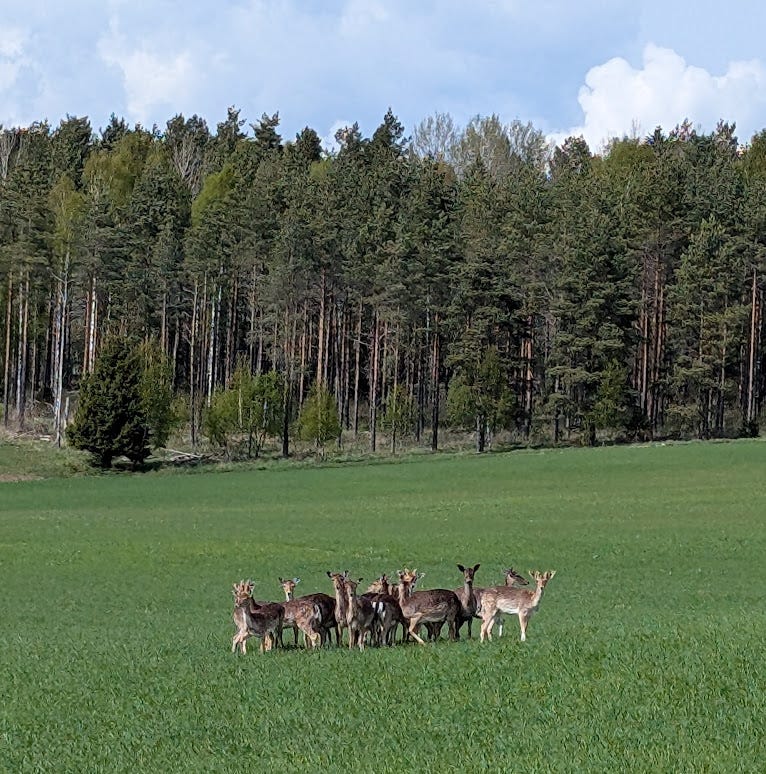
IN FRONT OF OUR FOREST HOUSE, photograph by the author
I will give the final word to Shakespeare today:
Shall I compare thee to a summer’s day?
Thou art more lovely and more temperate:
Rough winds do shake the darling buds of May,
And summer’s lease hath all too short a date;
Sometime too hot the eye of heaven shines,
And often is his gold complexion dimm’d;
And every fair from fair sometime declines,
By chance or nature’s changing course untrimm’d;
But thy eternal summer shall not fade,
Nor lose possession of that fair thou ow’st;
Nor shall death brag thou wander’st in his shade,
When in eternal lines to time thou grow’st:
So long as men can breathe or eyes can see,
So long lives this, and this gives life to thee.
-William Shakespeare SOURCE
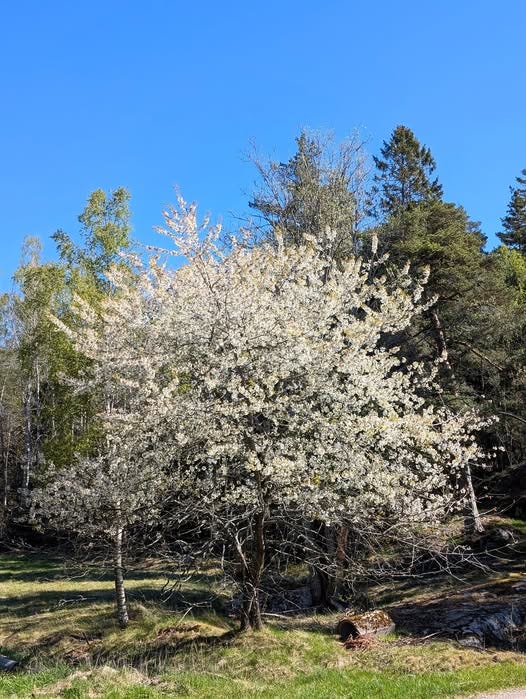
OUR BIRD CHERRY TREE THIS MORNING
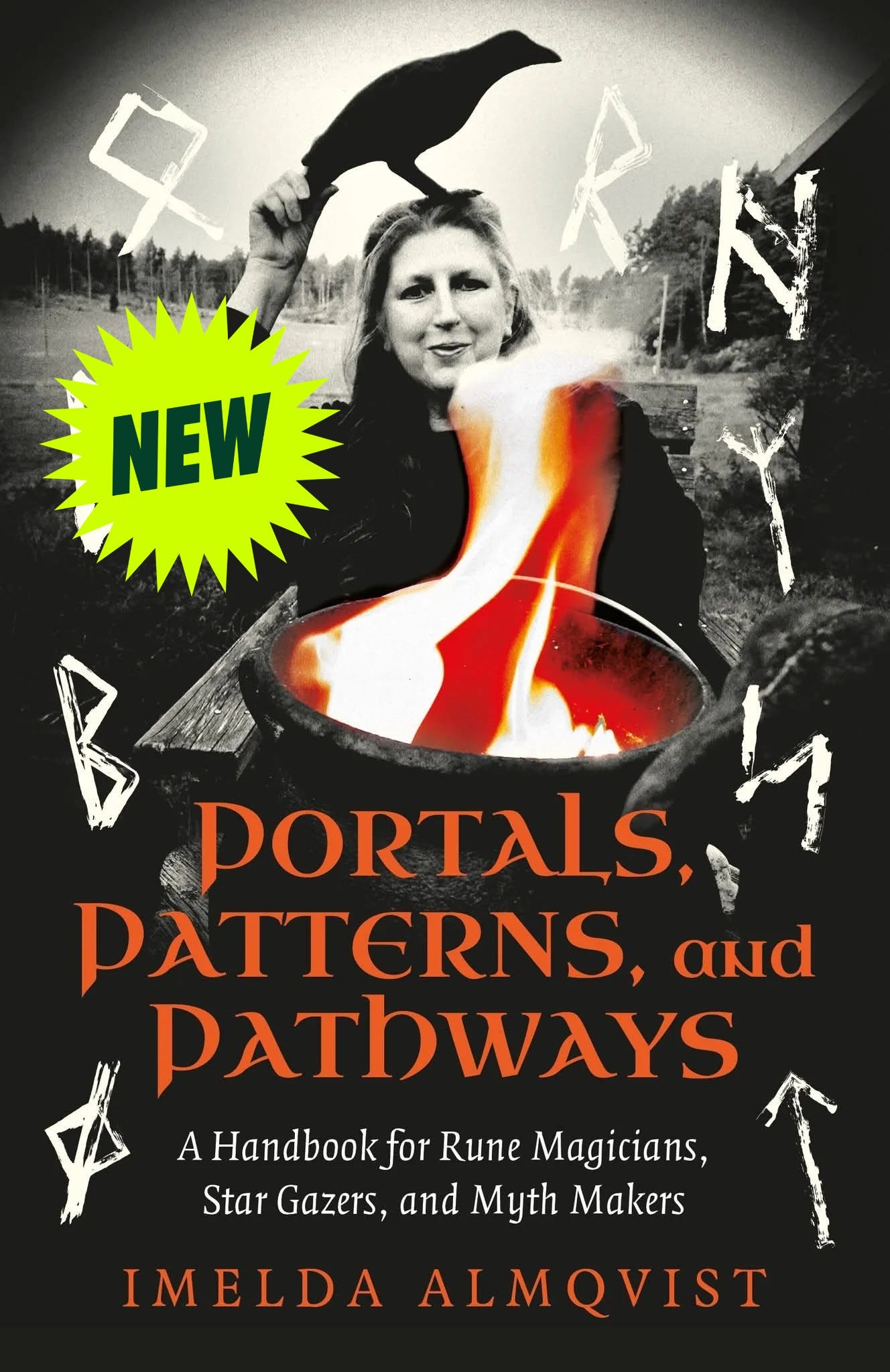
I try to send out two essays a week, but this sometimes fails due to travel, international teaching commitments and family care responsibilities (our family lives with Alzheimer’s and I have written several posts about that). If you would like to see regular posts about about Nordic spirituality and my life as a Forest Witch (and of course short videos of all the wildlife here!), please follow me on Instagram or Facebook, thank you! (And please check out my upcoming book about the runes, see the picture below).
As my audience here grows daily I need to add the following statement: ©I own the copyright to all my own words and images, as they appear here on Substack (or anywhere else). You can only reproduce this material (full or in part) elsewhere, if you give me full credit as the author and or artist. Most of you already knew this! Thank you!
Imelda Almqvist, Forest House and Forest School, Sweden
BIO FOR IMELDA ALMQVIST
Imelda Almqvist is an international teacher of Sacred Art and Seiðr/Old Norse Traditions (the ancestral wisdom teachings of Northern Europe). So far she has written four non-fiction books and two picture books for children. Natural Born Shamans: A Spiritual Toolkit for Life (Using shamanism creatively with young people of all ages) in 2016, Sacred Art: A Hollow Bone for Spirit (Where Art Meets Shamanism) in 2019, Medicine of the Imagination - Dwelling in Possibility (an impassioned plea for fearless imagination) in 2020 and North Sea Water In My Veins (The Pre-Christian spirituality of the Low Countries) was published in June 2022. Her latest book: Portals, Patterns and Pathways: A Handbook for Rune Magicians, Star Gazers and Myth Makers will be published (in the UK on May 26th and about a month later in the US).
The Green Bear is a series of picture book for children, aged 3 – 8 years. The stories and vibrant artwork, set in Scandinavia, invite children to explore enchanting parallel worlds and to keep their sense of magic alive as they grow up.
Imelda appears in a TV program, titled Ice Age Shaman, made for the Smithsonian Museum, in the series Mystic Britain, talking about Mesolithic arctic deer shamanism.
Imelda’s eagerly awaited book about the runes (the title is Portals, Patterns and Pathways, a Handbook for Rune Magicians, Star Gazers and Myth Makers) will be published by Collective Ink on 26 May 2026). She is currently working on a book about Inuit deities and mythology.
Imelda prefers being contacted by email. She only rarely checks (or responds) to DM’s on social media platforms.
Please note that Imelda’s on-line school called Pregnant Hag Teachings went off-line on 3 September 2025, due to a quadruple raise in fees imposed by the hosting platform. PUBLIC ANNOUNCEMENT AND FULL EXPLANATION
Website:
http://www.shaman-healer-painter.co.uk/
YouTube Channel: youtube.com/user/imeldaalmqvist
Facebook: https://www.facebook.com/imelda.almqvist/
Instagram: https://www.instagram.com/almqvistimelda/
Very interesting indeed! In German it's called Mai. Here in England it's often sunnier than June. I love all the blossoms and lush green.
Lovely! I'm always fascinated by the way different cultures express the calendar in their own languages.