
THE MIDSUMMER WITCH
A Danish Midsummer Song

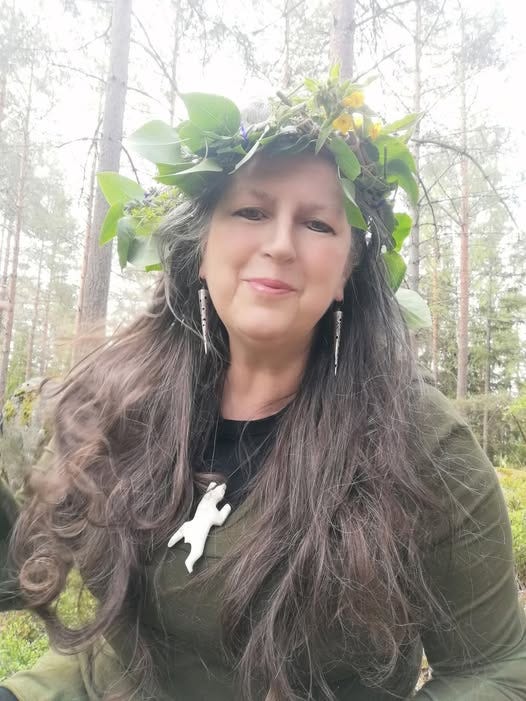
In response to an article I posted here to mark Valborgsmässoafton or Walpurgisnight, on April 30th, one Danish reader sent me a Midsummer Song from Denmark. Thank you Ea Himmelbjerg! With Ea’s permission I have made this song the topic of an article here.
A few practical notes first:
Below is the Midsummer Song (in full) in Danish but I have added (my own) translation into English, below every verse.
Please note that Johannes is the Danish version of the English name John and often abbreviated to Hans (so Saint Hans is actually St John!)
The relevant passage, (from our perspective, on the topic of witches), appears in verse #3. I have marked it in enlarged bold print so it is easy to spot, if you want to scroll fast through the original (probably incomprehensible) lyrics in Danish.
There is a VIDEO VERSION by Erling Jan Sørensen. Click on the link to watch it.
Midsommervise
1. Vi elsker vort land,
når den signede jul
tænder stjernen i træet med glans i hvert øje, BY
når om våren hver fugl
over mark, under strand
lader stemmen til hilsende triller sig bøje:
vi synger din lov over vej, over gade,
vi kranser dit navn, når vor høst er i lade;
//: men den skønneste krans
bli’r dog din, sankte Hans!
den er bunden af sommerens hjerter så varme, så glade. ://
We love our country, when the blessed Christmas lights (up) the star in the tree with shine in every eye, TOWN
When in Spring every bird, over land and beach, lets its voice tremble in greeting
We sing your praise over the road, over the street
We garland your name, when our harvest is in the barn
But the most beautiful wreath, is still yours, Saint Hans
Bound (crafted) from the hearts of summer
so warm, so happy.
2. Vi elsker vort land,
men ved midsommer mest,
når hver sky over marken velsignelsen sender,
når af blomster er flest,
og når kvæget i spand
giver rigeligst gave til flittige hænder;
når ikke vi pløjer og harver og tromler,
når koen sin middag i kløveren gumler:
//: da går ungdom til dans
på dit bud, sankte Hans!
ret som føllet og lammet, der frit over engen sig tumler. ://
We love our country, but most so at Midsummer
when every cloud over the fields sends a blessing
when the number of flowers proliferates
and when the cattle in the yard
delivers the gift of abundance to industrious hands
When we do not plough and harrow and roller
when the cow chews her meal in clover
Then the youths go dancing
at your command, Saint Hans (St John).
Just like the foal and the lamb tumble (bounce) carefree in the meadow
3. Vi elsker vort land,
og med sværdet i hånd
skal hver udenvælts fjende beredte os kende!
men mod ufredens ånd
over mark, under strand
vil vi bålet på fædrenes gravhøje tænde:
hver by har sin heks og hvert sogn sine trolde,
dem vil vi fra livet med glædesblus holde;
//: vi vil fred her til lands,
sankte Hans, sankte Hans!
den kan vindes, hvor hjerterne aldrig bli’r tvivlende kolde! ://
We love our country
And with the sword in hand
every foreign enemy had better prepare to know us!
But against the spirit of discord
over land and beach
We will kindle the fire on the burial mounds of our fathers
Every town has its own witch and every parish has its trolls
Those we want “out of life” with a blast of joy
We want peace here in our land
Saint Hans, Saint Hans!
It can be won where hearts never grow suspiciously cold
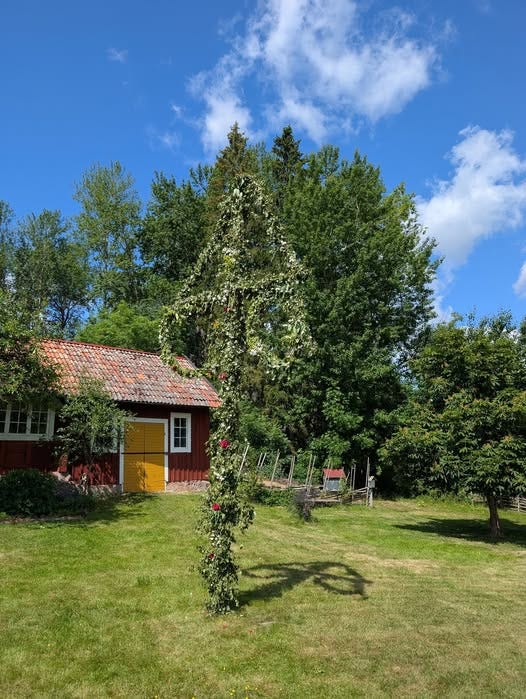
This song, Holger Drachmann’s version, is from one of the greatest success stories in the Royal Theatre: “Once Upon A Time”. There is the original melody (by P.E. Lange-Muller) and also a newer (jazzed-up) melody by Shu-bi-dua.
Many people might well think of this as a piece of “living folklore”. After all, these ideas remain deeply rooted in the Scandinavian folk mind. However, from my perspective, an entire nation belting out the words:
We will kindly the fire on the burial mounds of our fathers
Every town has its own witch and every parish has its trolls
Those we want “out of life” with a blast of joy
We want peace here in our land
… every year again, is nothing short of disturbing. Chanting or singing is a very potent way of activating or empowering something (such as a mindset or an old belief). At best “out of life” or “from life” could mean “at a safe distance from my own life” (or perhaps “well away from community life”), but it could also mean something more sinister.
Ea tells me that the feast day of St Hans (St John), June 23rd is also the national bonfire night in Denmark. People still make a witch effigy and burn it/her on the fire! This keeps the dehumanisation and demonisation of witches alive in a very graphic way. It keeps the image, of a witch being burnt at a stake, bubbling away in people’s minds (even if it festers mostly in the unconscious regions of the human mind).
PS from Ea Himmelbjerg:
Your translation from the 3rd, 'Those we want “out of life” with a blast of joy', misses something. 'Glædesblus' are bonfires. So it means,'we will keep them away by burning them', which is what Sct. hans is all about Bonfires everywhere. Even writing it is difficult, but that is what is means. I don't call myself a witch, but I am aware that had I lived then, I would have been called one and most likely killed. Also the joylly singing of killing other people is frightening to me. It reminds me of how the nazis had Jewish musicians playing Wagner at concentration camps. Lack of empathy, awareness and sense of decency.
In many previous articles I have written about the fact that the (so called) Witch Wound is still very much alive in the minds of many people (especially women, but men too). It contributes to many ordinary people not talking openly about their activities or interests (because of “the people in their village finding out”). Until today you can lose friends, or the goodwill of your neighbours (in smaller villages or rural areas), by “coming out” about witchcraft. People in big cities have the protective “cloak of greater anonymity”, which doubles as a Cloak of Invisibility. In the cities people carry less (historical, originating in a previous lifetime) fear of local people rocking up with their pitchforks and a mob mentality.
The phrase “Kill the witch!” still goes strong in Western culture (in our day it often refers to a relentless and biased campaign to persecute opponents or dissenting voices). Outside Western culture, thousands of vulnerable people are still harmed or even murdered every year, because people equate “being different”(in any way) with witchcraft and “wicked pursuits”.
For all of those reasons I find this song (and the notion of an entire nation belting out this song once a year) highly unfortunate (to put it mildly) but it is obviously not in my power to do anything about that.
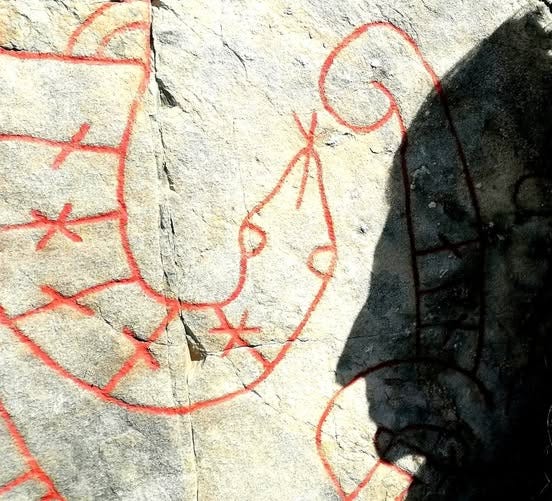
THE FACE OF THE WITCH APPEARS ON A RUNE STONE, selfie by the author
As always I invite you to share your own stories and experiences in the comment section.
Is anything like this happening in your country (of birth or residence)?
Is the Witch Wound still active within you or someone you love?
Thank you again for the topic suggestion, Ea Himmelbjerg!
I try to send out two essays a week, but this sometimes fails due to travel, international teaching commitments and family care responsibilities (our family lives with Alzheimer’s and I have written several posts about that). If you would like to see regular posts about about Nordic spirituality and my life as a Forest Witch (and of course short videos of all the wildlife here!), please follow me on Instagram or Facebook, thank you!
As my audience here grows daily I need to add the following statement: ©I own the copyright to all my own words and images, as they appear here on Substack (or anywhere else). You can only reproduce this material (full or in part) elsewhere, if you give me full credit as the author and or artist. Most of you already knew this! Thank you!
Imelda Almqvist, Forest House and Forest School, Sweden
BIO FOR IMELDA ALMQVIST
Imelda Almqvist is an international teacher of Sacred Art and Seiðr/Old Norse Traditions (the ancestral wisdom teachings of Northern Europe). So far she has written four non-fiction books and two picture books for children. Natural Born Shamans: A Spiritual Toolkit for Life (Using shamanism creatively with young people of all ages) in 2016, Sacred Art: A Hollow Bone for Spirit (Where Art Meets Shamanism) in 2019, Medicine of the Imagination - Dwelling in Possibility (an impassioned plea for fearless imagination) in 2020 and North Sea Water In My Veins (The Pre-Christian spirituality of the Low Countries) was published in June 2022. Her latest book: Portals, Patterns and Pathways: A Handbook for Rune Magicians, Star Gazers and Myth Makers will be published (in the UK on May 26th and about a month later in the US).
The Green Bear is a series of picture book for children, aged 3 – 8 years. The stories and vibrant artwork, set in Scandinavia, invite children to explore enchanting parallel worlds and to keep their sense of magic alive as they grow up.
Imelda appears in a TV program, titled Ice Age Shaman, made for the Smithsonian Museum, in the series Mystic Britain, talking about Mesolithic arctic deer shamanism.
Imelda’s eagerly awaited book about the runes (the title is Portals, Patterns and Pathways, a Handbook for Rune Magicians, Star Gazers and Myth Makers) will be published by Collective Ink on 26 May 2026). She is currently working on a book about Inuit deities and mythology.
Imelda prefers being contacted by email. She only rarely checks (or responds) to DM’s on social media platforms.
Please note that Imelda’s on-line school called Pregnant Hag Teachings went off-line on 3 September 2025, due to a quadruple raise in fees imposed by the hosting platform. PUBLIC ANNOUNCEMENT AND FULL EXPLANATION
Website:
http://www.shaman-healer-painter.co.uk/
YouTube Channel: youtube.com/user/imeldaalmqvist
Facebook: https://www.facebook.com/imelda.almqvist/
Instagram: https://www.instagram.com/almqvistimelda/
So many people, all over the world, sing folk songs by rote, without even thinking about the content and meaning of the words they're singing. They're perpetuating some problematic energies and ideas with this one. Thank you for pointing it out. At least those of us who are aware of its implications can avoid it.
Hi Imelda
Your translation from the 3rd, 'Those we want “out of life” with a blast of joy', misses something. 'Glædesblus' are bonfires. So it means,'we will keep them away by burning them', which is what Sct. hans is all about Bonfires everywhere. Even writing it is difficult, but that is what is means. I don't call myself a witch, but I am aware that had I lived then, I would have been called one and most likely killed. Also the joylly singing of killing other people is frightening to me. It reminds me of how the nazis had Jewish musicians playing Wagner at concentration camps. Lack of empathy, awareness and sense of decency.