
GOING TO ODIN
Choosing our Time of Death (an Old Norse perspective)

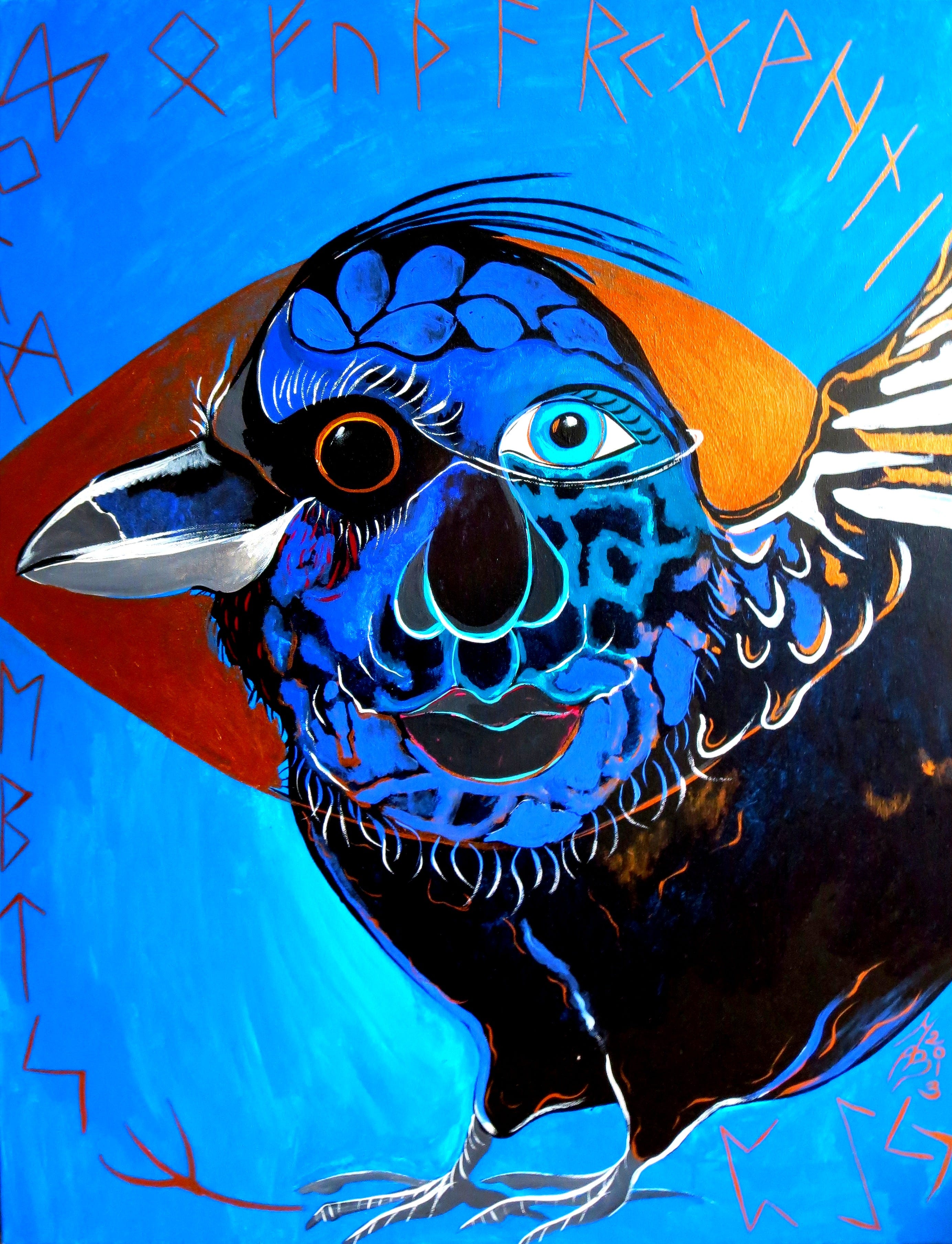
ODIN, painting by the author (up on the wall of my Forest School!)
Today’s article follows on from a piece I posted a few weeks ago, because one reader asked me to share my perspective on SUICIDE. One response received in the comment section (which I am not going to reproduce here, but you can read it below the relevant post) made me realise that I had left out an old, ancestral Northern European yet (perhaps) key perspective. Today I am going to present that perspective for reasons of balancing.
The Old Norse people (this is one specific period I teach, the Viking Age) used to believe that ultimately only the Norns (or the Powers of Fate, personified by three women) could decide when a human life starts and ends. In that worldview believing anything else is “grandiosity” or “delusion” on behalf of human beings.
However, let me pad out the background a little before we return to the Norns. The Vikings lived by a Code of Honour. The worst thing that could happen to someone was to lose their honour. Dishonourable acts had very serious consequences for an individual (such as being outlawed and leading a precarious life on the run, in a very harsh climate, unable to ever return to their community). For the time they had left on earth, they existed outside the protection of the law and anyone could kill them without consequences. However, their choices also had huge consequences for their kith and kin. Not only did their relatives live in shame (or the shadow cast by dishonourable acts) but the family “luck” or fortune was impacted as well, meaning even future generations grappled with this “shadow of dishonour and ill-fortune”, cast over their lives.
For the reasons explained above, the Vikings did not fear death too much (after all Warriors were secure in the knowledge and promise that Odin would receive them at Valhalla, where they would join his legion of Einherjar, elite warriors, who will eventually fight at Ragnarök). One of their greatest fears was not dying a heroic death, as in a death suitable for a warrior of their standing.
The Old Norse people had the concept of a “straw death”. Instead of modern mattresses, they slept on straw pallets. So a “straw death” meant dying the death of an ordinary (insignificant) person in their own bed. And that meant going to Helheim (the more humble, but perfectly welcoming, realm of Norse goddess of death, Hel, not to be confused with the Christian concept of Hell!) after death, not the far more desirable and glorious Valhalla.
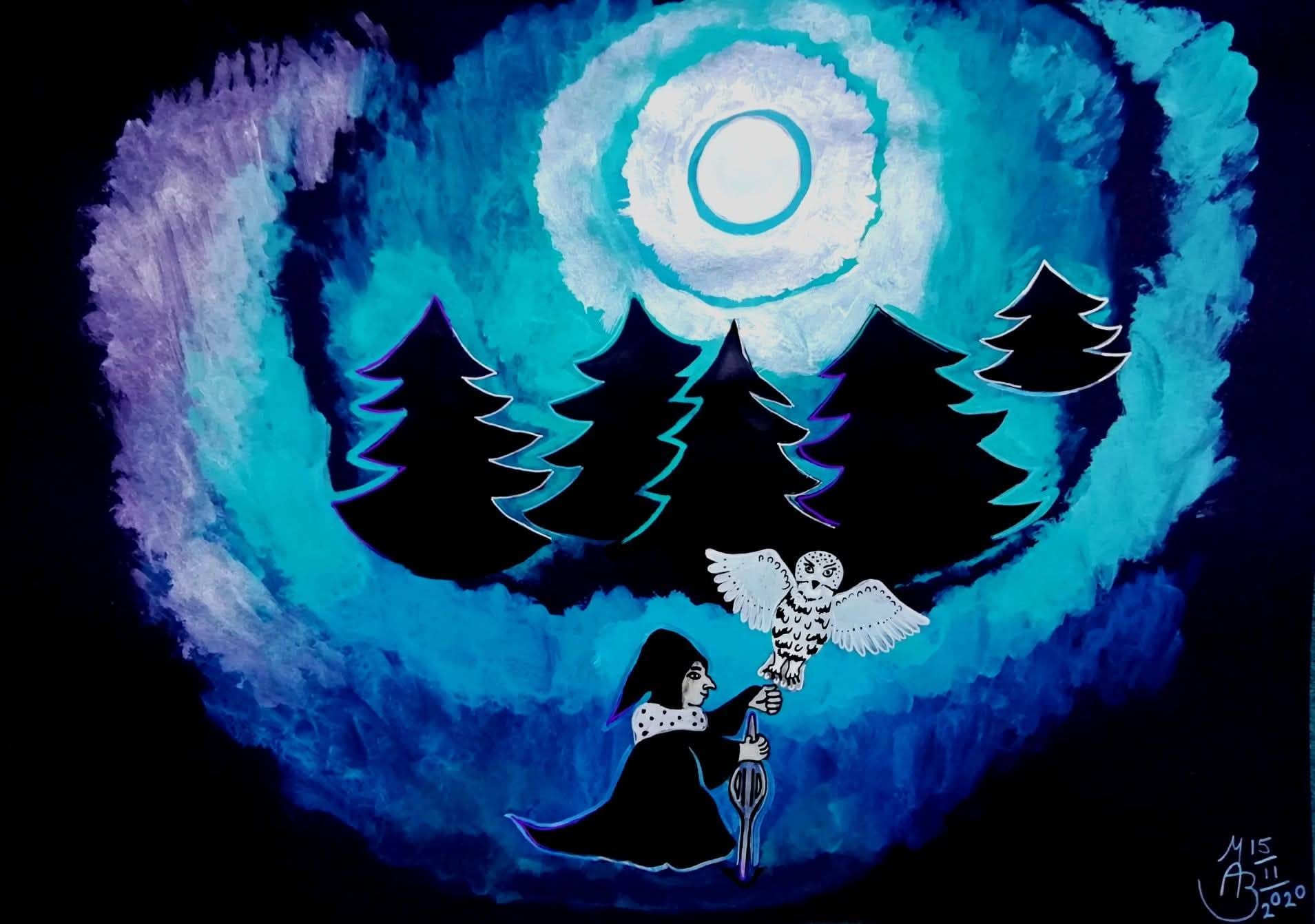
ON THE NIGHT OF THE FOGGY OWL MOON, THE VOLVA CALLS HER OWL (painting by the author)
This sometimes created situations where warriors had to make a tough choice. There are accounts where a Viking would “throw themselves on their own sword” (in battle). This was done to escape a more ignominious fate (such as being taken prisoner and living in slavedom imposed by the enemy).
In Njal’s saga, Njal finds himself trapped in a house fire, in his own home. The fire is blazing all around him. The flames are consuming everything and approaching Njal fast. Njal then actually receives an offer to escape from a man called Flosi, one of the “architects of the fire”, but Njal refuses. Njal was not going to abandon his home and his sons.
Njal is too old to fight anyway (in case Flosi and his other enemies decide to betray him, despite their promise of safety). And even if he did manage to escape unharmed, he would die shamefully of old age (the dreaded “straw death”).
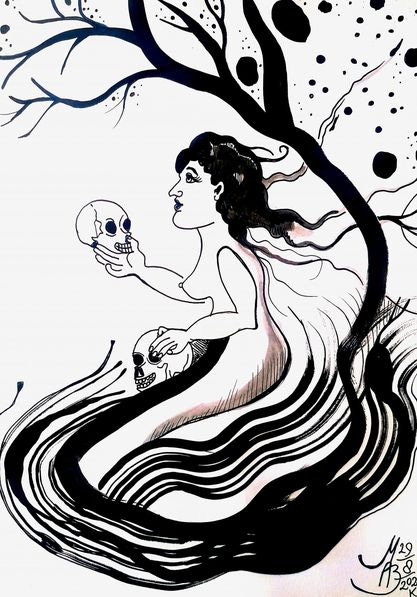
TENDING THE ANCESTRAL SKJULLS, pen-and-ink drawing by the author
In Gautrek’s Saga we find a similar approach to both honour and death. This saga describes a “Family Cliff” as the location where family members throw themselves off the edge to reach the Afterlife. This desperate move was called “going to Odin”.
This concept, translated into “going to God”, does not work in contemporary culture because we are generally taught that “Only God gives Life and only God takes Life” (even if we are not practicing Christians but Christianity remains a dominant influence on our culture, and a deeply-rooted filter of perception in Western culture).
Flosi had allowed the women and children to leave the house. So, if Njal had accepted his offer, of escape from a burning house, this would have placed him on the same level as vulnerable women and children. At this time in history that was a shameful prospect and Njal never entertained it. (Remember, we are talking about the Viking Age here! Powerful female warriors definitely existed but this did not included the womenfolk in Njal’s house - and then there were the children requiring safety and care).
Shame was a huge shaping force in Viking society, but it presents itself in a different way in Gautrek’s saga, in the actions of the family patriarch Skinflint. One member of this family, called Snorta, returns home after a long absence and discovered that her father, Skinflint, was giving away all his possessions to various family members. This gave Snorta a sense of foreboding.
It transpired that a king had visited the family (in those days there were many local kings, not one king for a large unified country as is the case today) and Skinflint was at his wits’ end in the aftermath of this (very taxing) royal visit. The family was left with depleted food stores and shortfalls in all other resources too. In other words they were “reduced to poverty” after the unwanted visit. Skinflint had decided to take his wife along with him to Valhalla, and his personal slave as well.
Side note: the Swedish language still has a word for the phenomenon described here: våldgästa. It means visiting by means of using violence or force, so forcing your company on someone and making them provide for you. (I guess the closest word in English is gate-crashing, but that usually involves a party and only one night of mayhem!)
Back to Gautrek’s Saga: Snorta and her siblings then accompany their parents to the Family Cliff and watch as Skinflint, their mother, and also their father’s slave go “merry and bright, on their way to Odin”.
Skinflint was perfectly aware that his decision meant three mouths less to feed. Skinflint even views his actions as a favour to the slave (the word “murder” would not have crossed his mind). He claimed that it was “the least I can do” to reward the slave’s heroic efforts in resisting the king’s entry into the house. Of course we also need to acknowledge that this drastic solution (kind of) “worked”, in the sense that both Njal and Skinflint (and other characters in the household) were immortalised in the famous Hero Sagas that we still read today.
As promised, we will now return to the Norns or female Powers of Fate, said to be more powerful even than the Norse gods because they also carve the fate of same gods!
Did Njal and Skinflint kill themselves? Yes, technically speaking they did (because they both had other options). But the stories also make it very clear that this was the only honourable course of action left to them. After all, the Norns had carved this fate for them and put them into these impossible situations! And they dutifully acted as heroic men were supposed to act…
If we follow this (Old Norse) belief to its logical conclusion, people can only successfully end their lives if the Norns have (in the Old Norse wording) "carved that fate for them". If the Norns hadn’t decided this, it would not have happened because it would not have been their time to die.
We can take that even one step further and say: if the Norns have not carved death for a person, their suicide attempt will fail. It is not (yet) their time to die. The Vikings often “went berserk” and took immense risks in battle, because they reasoned that “if the Norns haven’t carved it (this outcome, my death), I am not going to die today!” (Maybe not, but they could still have ended up with a serious injury or disability without modern medical care, and a straw death looming).
In advanced Seiðr classes I take my students through this worldview. It generally turns our core sense of individualism, agency and even narcissism ("I create my own reality, I manifest by using the Law of Attraction") completely upside down. In plain English: this perspective can make modern people (momentarily) feel quite disorientated.
But there may be comfort in this perspective as well.
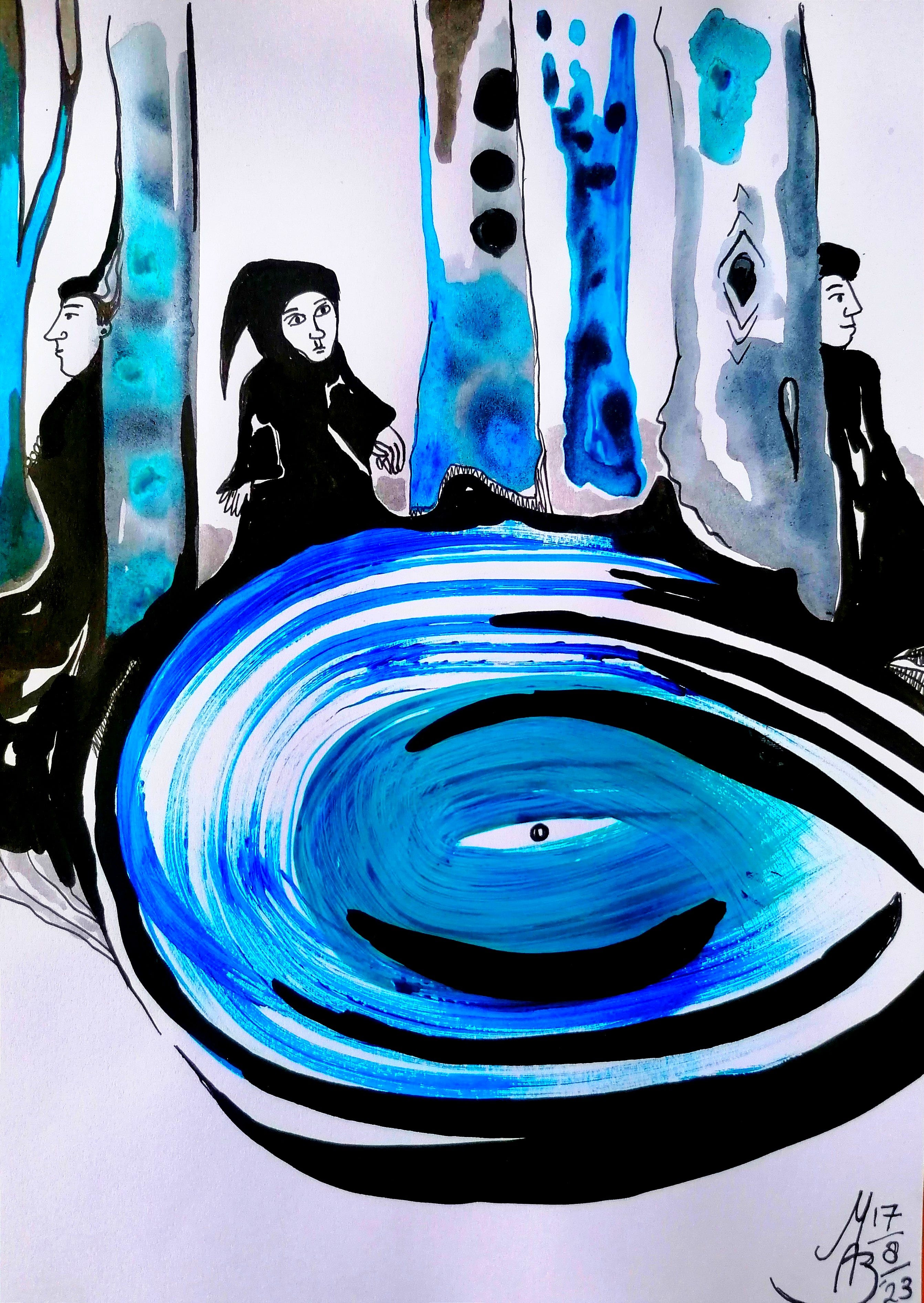
MIMISBRUNNR (Mimir’s Well), mixed media sketch by the author
It also flips the “shame angle” upside down. In Western culture we often see suicide as “the failure to make a better choice”, “the failure to seek adequate help” or a betrayal of loved ones, “how could you do this to the people who love you?”. In the Old Norse way of thinking, suicide by one’s own sword (or the Family Cliff, a house fire or some other heroic means) is the honourable way to go. If we subscribe to this belief (and I know that most of us don’t!) our nearest and dearest would take pride in our choice and even bask in the glory of this. “They did the honourable thing!”
In contemporary society the closest scenario (to this conceptualisation) that I can think of is of people who lose their lives in an attempt to save another person’s life. They die in a house fire or they drown in the sea (or sometimes they are shot by a terrorist while shielding someone else). But they saved another human being’s life and that makes them heroes. They are profiled as such in newspapers (and on social media) and their loved ones derive a degree of comfort from that. “They didn’t die in vain, they died a hero’s death”. After all, another person is alive because of their sacrifice! (And we would never refer to their actions as suicide).
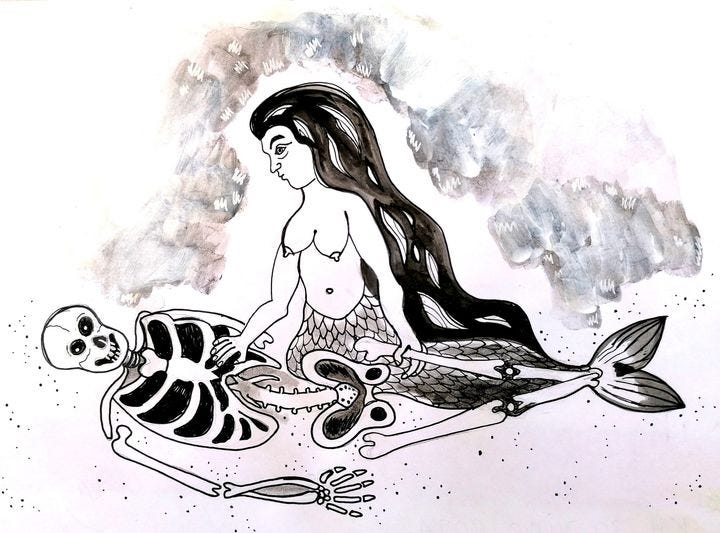
LOOSING HALF OF MYSELF, pen-and-ink drawing by the author
Dying “a straw death” would have cast dishonour on the (larger) family, not only our modern small “nuclear family” but the entire kinship community. To preserve honour (and with it the hamingja or store of good family fortune), a Viking man would go to great lengths and often act on higher priorities than sheer self-preservation.
I just wanted to add this perspective, as a follow-up article, to the piece I wrote earlier. Did you find this interesting, or a very alien way of reasoning? It might (just) have meaning for someone in my audience (and if so, do leave me a comment please).
Oh and just to be very clear: I am NOT promoting that we all go and live by Old Norse values or that we actively start “glorifying” suicide. As a teacher of this material I am just offering an alternative way of looking at a tragic (yet common) situation, in the spirit of looking at the issue from all possible angles (as I often do in my articles). No more and no less.
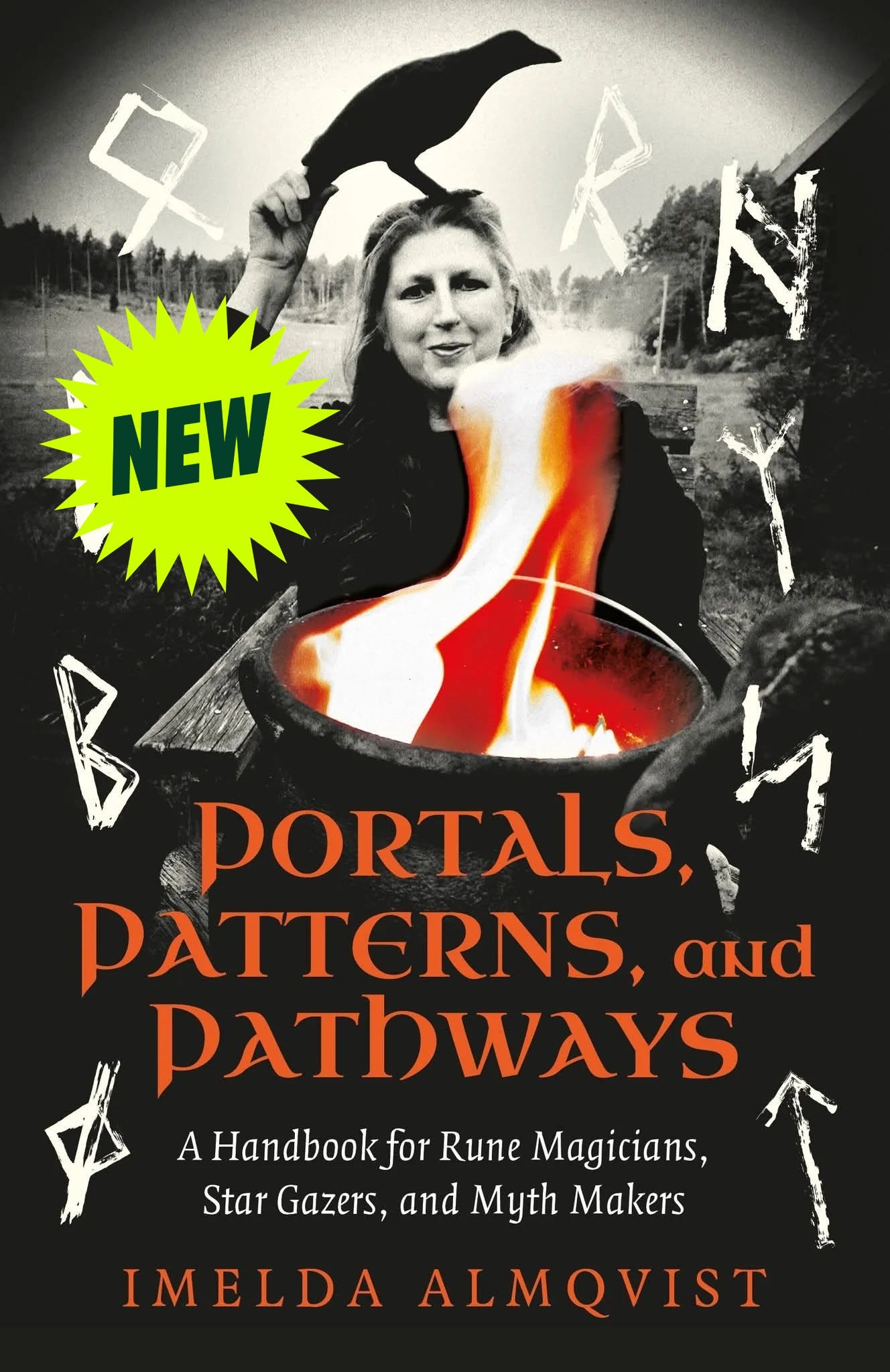
As always I look forward to reading about your experiences and thoughts in the comment section! And if you are interested in the Viking Era, please check out my upcoming handbook for rune magicians, out on May 26th in the UK and about a month later in the US and Canada etc., thank you!
I try to send out two essays a week, but this sometimes fails due to travel, international teaching commitments and family care responsibilities (our family lives with Alzheimer’s and I have written several posts about that). If you would like to see regular posts about about Nordic spirituality and my life as a Forest Witch (and of course short videos of all the wildlife here!), please follow me on Instagram or Facebook, thank you! (And please check out my upcoming book about the runes, see the picture below).
As my audience here grows daily I need to add the following statement: ©I own the copyright to all my own words and images, as they appear here on Substack (or anywhere else). You can only reproduce this material (full or in part) elsewhere, if you give me full credit as the author and or artist. Most of you already knew this! Thank you!
Imelda Almqvist, Forest House and Forest School, Sweden
BIO FOR IMELDA ALMQVIST
Imelda Almqvist is an international teacher of Sacred Art and Seiðr/Old Norse Traditions (the ancestral wisdom teachings of Northern Europe). So far she has written four non-fiction books and two picture books for children. Natural Born Shamans: A Spiritual Toolkit for Life (Using shamanism creatively with young people of all ages) in 2016, Sacred Art: A Hollow Bone for Spirit (Where Art Meets Shamanism) in 2019, Medicine of the Imagination - Dwelling in Possibility (an impassioned plea for fearless imagination) in 2020 and North Sea Water In My Veins (The Pre-Christian spirituality of the Low Countries) was published in June 2022. Her latest book: Portals, Patterns and Pathways: A Handbook for Rune Magicians, Star Gazers and Myth Makers will be published (in the UK on May 26th and about a month later in the US).
The Green Bear is a series of picture book for children, aged 3 – 8 years. The stories and vibrant artwork, set in Scandinavia, invite children to explore enchanting parallel worlds and to keep their sense of magic alive as they grow up.
Imelda appears in a TV program, titled Ice Age Shaman, made for the Smithsonian Museum, in the series Mystic Britain, talking about Mesolithic arctic deer shamanism.
Imelda’s eagerly awaited book about the runes (the title is Portals, Patterns and Pathways, a Handbook for Rune Magicians, Star Gazers and Myth Makers) will be published by Collective Ink on 26 May 2026). She is currently working on a book about Inuit deities and mythology.
Imelda prefers being contacted by email. She only rarely checks (or responds) to DM’s on social media platforms.
Please note that Imelda’s on-line school called Pregnant Hag Teachings went off-line on 3 September 2025, due to a quadruple raise in fees imposed by the hosting platform. PUBLIC ANNOUNCEMENT AND FULL EXPLANATION
Website:
http://www.shaman-healer-painter.co.uk/
YouTube Channel: youtube.com/user/imeldaalmqvist
Facebook: https://www.facebook.com/imelda.almqvist/
Instagram: https://www.instagram.com/almqvistimelda/
Thank you for this very interesting post and the beautiful artwork. It chimes with me in many ways. A couple of days before my dad passed away,aged 98, he exclaimed in desperation that he didn't have the will to go on and wondered when this (living hell) was going to be over. The fates were kind and his wish was granted 2 days later. He'd broken one of his legs to add to his other medical problems. Mum followed soon after. I knew exactly how he felt. I've been living with ME and Fibromyalgia for a very long time and I've had many moments when I wished I could cross over. I wouldn't harm myself, but sadly there are many others with the same illnesses who have chosen to end their lives due to lack of interest, understanding and compassion by the medical profession. In recent times more research has been carried out but we're still a long way away from a diagnostic test and appropriate treatment regime that would offer people with these conditions the care and dignity they deserve. Government support in terms of benefits is very difficult to obtain with neurological conditions such as these as they're "invisible" and fluctuating in nature. I don't blame anyone who decides to end their lives out of desperation, but I wish our society could become more compassionate and respectful of those who struggle to keep up and allegedly don't contribute to society.
Thank you, Imelda for writing both. I find the old Norse way interesting especially bc we now view it differently. Although I am not subscribing to the viking view, I do think we need to soften our judgment of old and ill people who might not want to spend their last months in excruciating pain and opt for ending their life. I don't find that shameful. That is(or at least it could be) a sovereign choice.